We called it Project Moonshot because, honestly, we weren't sure it would work.
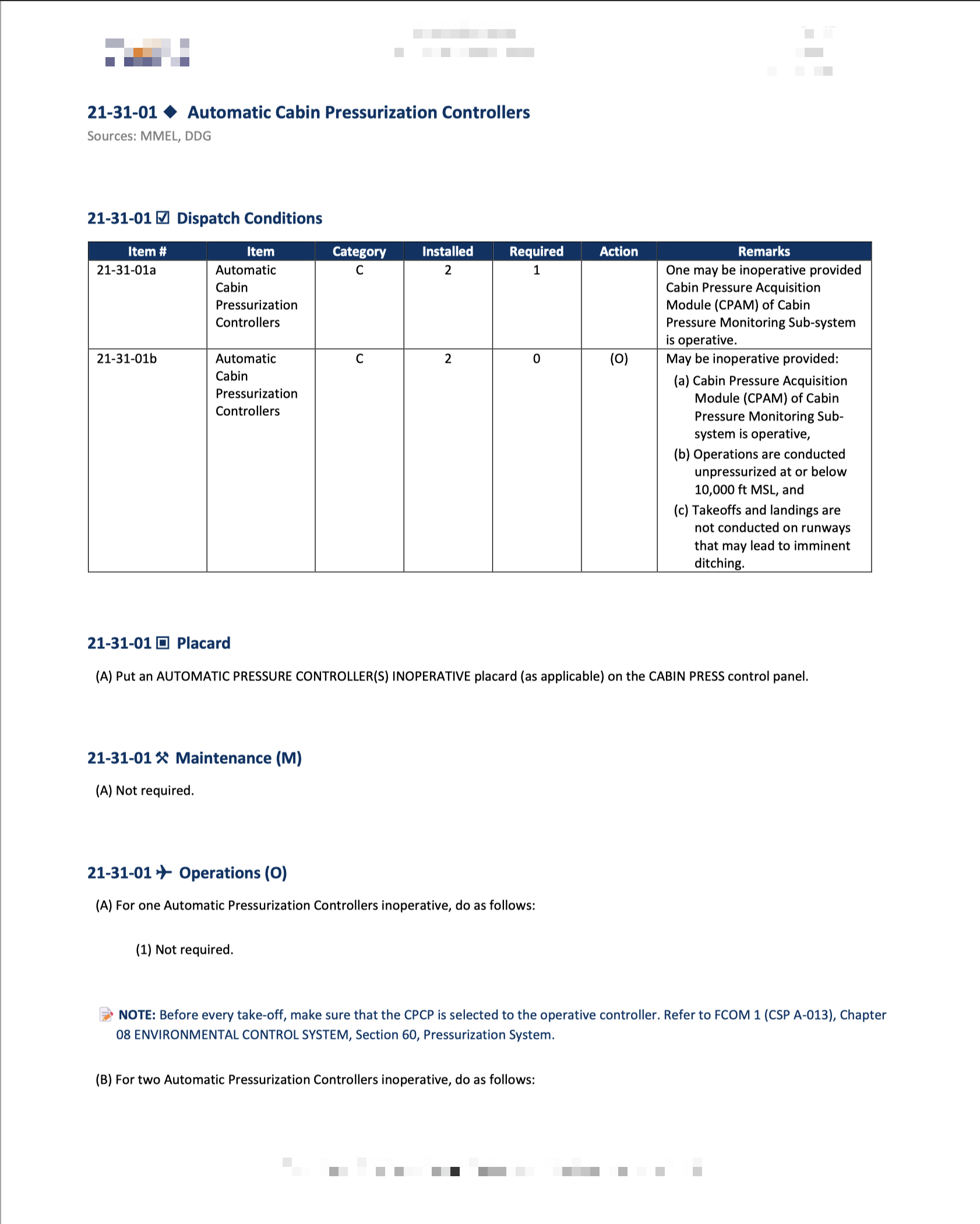
The goal was to build an AI system that could generate a Minimum Equipment List (MEL), one of aviation's most complex regulatory documents, for Transport Canada approval and use in flight operations.
Transport Canada approved our AI-generated MEL after just two rounds of feedback.
Here's how we did it.
Why MELs are a nightmare
If you've worked in aviation operations, you know MELs. If you haven't, here's the short version: a Minimum Equipment List defines exactly what equipment can be inoperative on an aircraft while still maintaining airworthiness. Every item requires cross-referencing multiple regulatory sources:
- Manufacturer's Dispatch Deviation Guide (DDG), the master minimum equipment list (MMEL)
- Transport Canada's Master MEL
- Minimum equipment list procedures (MELP)
- Temporary revisions and amendments
- Supplemental Type Certificates (STCs) for modified aircraft
- Other operator-specific documentation
One MEL entry might require checking four different documents. A complete MEL has hundreds of entries.
Operators rarely start a MEL from scratch. They inherit them from previous certificate holders, acquire them from other operators flying the same type, or layer amendments onto documents that have been passed around for years. The result is files that carry forward legacy issues: formatting problems, corrupted structures, inconsistencies that compound with every amendment cycle.
Traditionally, this means weeks of manual work by subject matter experts, plus multiple rounds of regulatory feedback before approval. And when Word documents corrupt (which they do), you're rebuilding on a broken foundation.
We thought: what if we could teach AI to do the cross-referencing, and start clean?
The hard parts nobody warns you about
Extraction was the first wall
Manufacturer documents don't play nice with software. The DDG/MMEL format uses cascading tables and complex nested structures that broke every standard extraction tool we tried. Worse, many PDFs (Portable Document Format files) include scanned approval cover letters that block text conversion entirely.
We trained an AI extraction engine for aviation technical documents. It parses each item, including the structures standard optical character recognition (OCR) tools could not read.
Assembly was the second wall
Once we had the data, we needed to build actual Word documents, because that's what regulators expect, and Word's track changes feature is critical for the review cycle between tech pubs and flight operations.
We built:
- Programmatic document assembly with intelligent aircraft configuration filtering
- A custom procedure database for operator-specific maintenance requirements
- A formatting engine that handles source document inconsistencies (official manufacturer documents have typos, so we had to teach the system to recognize "taht" as "that")
Then we had to prove it worked
We built a reconciliation pipeline to compare our AI-generated MELs against existing approved operator documents. The plan was to catch AI errors before submission.
What actually happened: the AI consistently found discrepancies that humans had missed. Items that should have been flagged. Cross-references that were slightly off.
We went from "let's double-check the AI's work" to "the AI is better at this than we are."
Thorough human review before submission
The AI generated complete Word documents in the format regulators expect, with track changes enabled for the review cycle. But we didn't submit the output blindly.
Our subject matter experts reviewed every page, line, and cross-reference to verify the AI output met the standard. That combination of AI speed and human oversight is what made Transport Canada comfortable approving it.
The results
| Metric | Traditional Process | Project Moonshot |
|---|---|---|
| New aircraft MEL from scratch | Several months | Less than 1 week |
| Regulatory approval cycles | 3-5 rounds typical | 2 rounds |
| Cross-reference accuracy | Human error rate | Exceeds manual review |
AI-generated MEL submitted. Two feedback rounds. Transport Canada approved.
What this actually means
When a manufacturer releases a service bulletin, we can update the MEL in days instead of weeks. When an operator adds a new aircraft type, a brand-new MEL that used to take months is ready for review in under a week, once the source materials arrive. When regulatory requirements change, compliance happens fast.
Operators also don't need to pay consultants premium rates for rush turnaround anymore. The bottleneck isn't human capacity.
The reconciliation process also showed that the system caught discrepancies human reviewers had missed.
Transport Canada approved the document.
The bigger opportunity
Here's what we learned that goes beyond our own project.
The approval process could use the same tools. Regulatory bodies use sampling methodologies to review submissions because they can't check every line of a 400-item MEL. AI could check every line. An AI-assisted review process could validate submissions almost instantly, flagging genuine discrepancies and cutting out the multi-month cycles that currently delay operators.
We've started conversations with industry groups about this. The same tools that help operators create better submissions could help regulators review them faster. Operators get approvals in days instead of months. Regulators can focus their expertise on edge cases and judgment calls rather than cross-reference verification.
The tools exist; regulators would need to decide whether to use them.
What's next
Project Moonshot was our proof of concept. The same approach, AI extraction, intelligent assembly, automated validation, applies across aviation documentation:
- Operations manuals
- Maintenance procedures
- Training documentation
- Regulatory compliance packages
We are extending the approach to more documentation so regulatory updates can take days instead of weeks, and people can spend their time on judgment calls rather than checking tables.
Interested in AI-assisted aviation documentation? Contact us to learn more about how ForIT can modernize your technical publications process.
Benjamin Thomas
ForIT Team