Crew records are the paperwork bloodstream of an airline: licences, medicals, ratings, training certificates — hundreds of documents, every one of which must be current before a crew member can legally fly. At one Transport Canada–regulated scheduled airline, keeping that bloodstream healthy consumed a two-person records function, plus roughly 20 hours a week of combined postholder time — the chief pilot and chief flight attendant personally re-checking spreadsheets every week.
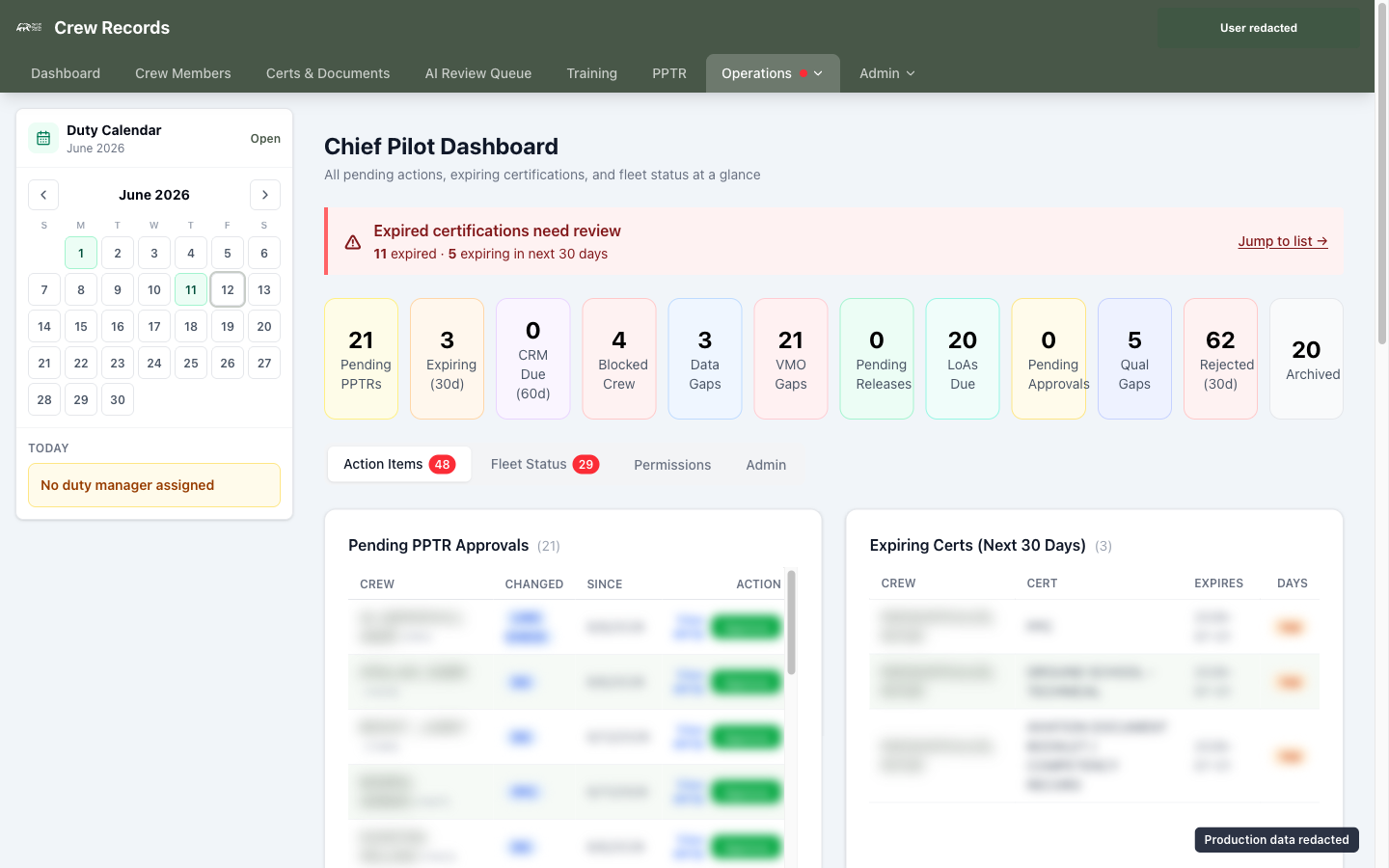
Today that airline manages 42 active crew and nearly 600 certifications with one person: the chief pilot, in a review that takes one click per record. The system we built is the airline's system of record across two fleets — every certification, sim session, and currency date in one place, replacing the spreadsheet the operation ran on before.
Here's the process — and why the human in the middle of it is the whole point.
Step 1 — Documents ingest themselves
Certificates and training records arrive the way they always did: email attachments from training providers, uploads from crew, scans from the office. The system watches those channels and pulls each document in automatically. Nobody re-types anything; nobody files anything. Every inbound document lands in a review queue — nothing enters the record silently.
Step 2 — AI verifies, and says how sure it is
For each document, AI extracts and checks the substance: is this the right crew member? The right rating or licence? Are the dates valid, the conditions met, the issuing authority what it should be? Discrepancies get surfaced instead of buried.
Critically, the AI also reports its own confidence. A clean, unambiguous certificate arrives pre-verified. A low-confidence extraction arrives flagged — "Recommend: reject — extraction uncertain" — with the mismatch spelled out. The AI's job ends at a recommendation.
We didn't build it this way because the AI is infallible. We built it this way because it isn't.
Step 3 — A person approves. Every time.
This is the piece we designed the whole system around: the AI never approves a record.
The chief pilot sees the original document and the AI's verification side by side — what was extracted, what was checked, what didn't line up. Concur, and it's one click. Disagree, and the record is edited or rejected on the spot. Every record that enters the system of record crosses a qualified postholder's desk; the AI just did the reading, cross-checking, and queueing that used to consume the week.
Consent gets the same treatment: document owners who haven't opted in to AI extraction are processed by staff manually — the pipeline is built PIPEDA-consent-first, not consent-as-afterthought.
Step 4 — Approved once, correct everywhere
On approval, the record flows automatically to the scheduling system (FL3XX) and the pilot records database. Nothing is typed twice, so the systems can't drift apart. It's in daily use — records were moving through it the week we wrote this.
Certificates are only part of it
The same system tracks simulator and initial training, medicals, and flight-log currency — and enforces qualification gates that catch an unqualified assignment before it happens, not after. Expiry alerts go out before a date lapses, so the chief pilot is scheduling recurrent training instead of discovering a lapsed cert on a duty day.
And every read and write is logged. When a regulator asks who approved a record and when, the audit trail is already assembled — not reconstructed from an inbox.
What it added up to
- ~40 hours a month returned to each of two postholders — the better part of a thousand postholder-hours a year, back to running the operation.
- 42 active crew, nearly 600 certifications, one person — the two-person records function it replaced is gone.
- Two fleets, one system of record — every certification, sim session, and currency date.
- Validated by Transport Canada.
- Passed an Air Canada operational review — records produced this way stand up to the regulator and to airline-partner scrutiny.
The pattern that keeps working
This is the same shape as our Transport Canada–approved AI-generated MEL work (see: Project Moonshot): AI does the reading, extraction, and cross-checking at machine speed; qualified humans review and approve every output that matters. AI speed, human accountability. That combination is what regulators approve — and what operators actually trust.
If your records function runs on spreadsheets and a postholder's Saturday, this is a solved problem. Building something similar? Talk to us at forit.io.
Benjamin Thomas
ForIT Team