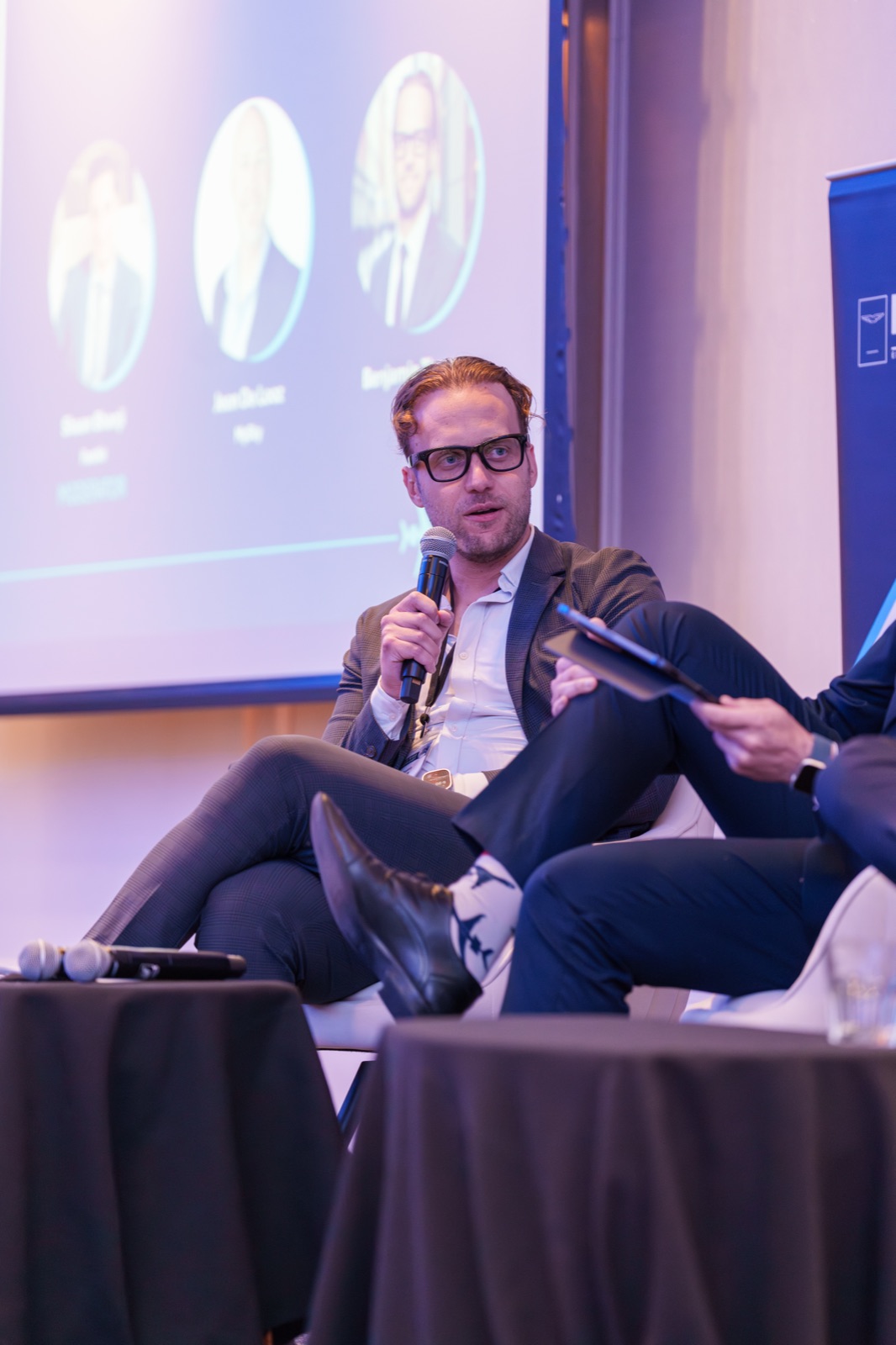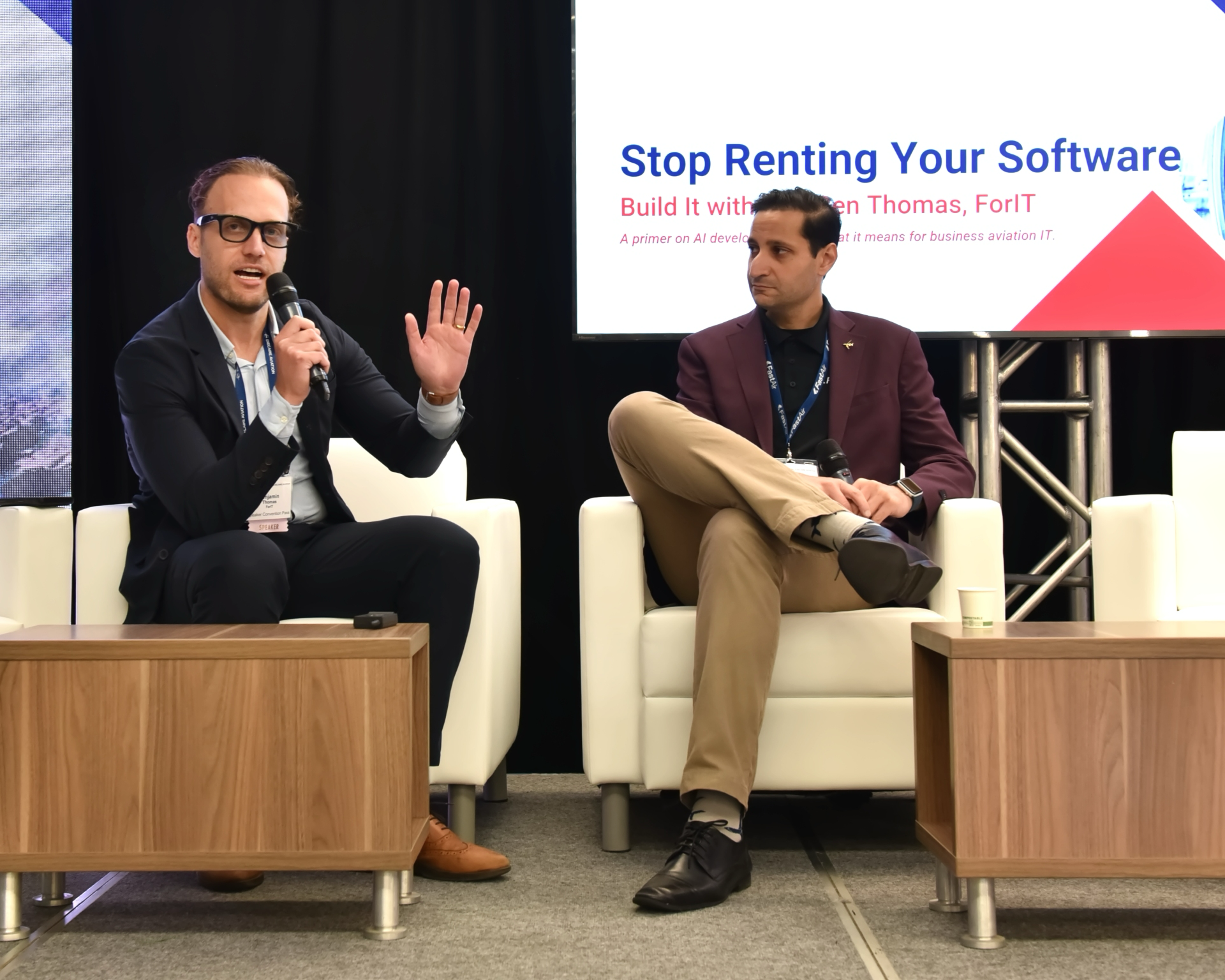
We took the Innovation Stage at CBAA 2026 in Calgary on June 11 with a talk called "Stop Renting Your Software. Build It with AI." We ran it as a fireside chat and kept time for the room's own questions — and the room pushed back, which made it better. Here is the whole argument, for the people who were there and the ones who were not.
Count your software. The number is bigger than you think.
We opened with a question for the operators in the room: guess how many pieces of software it takes to run your operation. Most hands landed around 30. In every full audit we have run, the real number has come back over 100 — every single time.
Start with the stack you would name without thinking. Scheduling. Quoting. Maintenance tracking. CRM. The document portal. Duty-time. Expenses. That is seven before anyone breaks a sweat.
Now add the shadow IT, the part nobody puts on the list. The spreadsheets. The side tools. The one critical workbook that lives on a dispatcher's desktop and would take the operation down if the laptop died. That is software too — and it is usually the part nobody has secured, backed up, or even licensed.
That whole pile is your application portfolio. Most operators have never actually counted it. And every line on it is a bill, every month, forever. You are not buying these tools. You are renting them, and the rent never stops. The numbers get silly fast — a single piece of software can run well into the mid six figures a year, and that is before you add up the rest of the portfolio.
There is a compliance edge to this, too. If you carry cybersecurity insurance, you are almost certainly attesting that you know every application you run and that each one clears a security bar. When you cannot even name all 100-plus, that signature is a problem waiting to surface — we have been the person signing that attestation at renewal, and it is not a good feeling when the list is a guess.
For thirty years, renting was the only sane answer
Every app on that list was once a decision: build it, or rent it. For thirty years in this industry the answer was always rent. That was not a failure of nerve. The math was genuinely against building.
Business aviation is a small market, a few thousand operators worldwide. Vendors build for the size of the market, so you got something generic, built once, priced at a premium to make it pencil out. Then it got worse three ways. Per-seat pricing scales against you, so the better your year, the more you pay for the same software. Your data lives in their database, so you rent access to your own flight history and customer list. And every tool is an island, so you pay a second tax in human hours retyping data between systems that were never going to integrate.
People call this underspending on technology, like it was timidity. It was not. Renting generic, per-seat tools genuinely paid badly, and you had no other option. You were right to be skeptical. The math just changed.
What "build it with AI" actually means
No magic in it. You describe the tool you need in plain language, the way you would explain it to a sharp new hire. The AI writes the working code. A technical person steers it and checks it, the way an editor checks a fast writer. That is the whole thing.
It is not autonomous. There is no robot running your company. A human is accountable for every line that ships. What changed is cost and speed. The part that used to take a team of developers months now takes one steerer and a domain expert a few weeks. Call it a 10 to 100 times collapse in the time and cost of building software.
Someone asked about "vibe coding," so we explained the buzzword plainly. It is the shift from an engineer reviewing every single line the AI writes to letting the AI generate the bulk of it and moving your attention to testing — proving the thing is correct, that it does not break in some other corner, that it is genuinely production-ready. The skill stops being typing code and becomes knowing what to check.
Here is the part that surprises people. The scarce ingredient in good aviation software was never the code. It was the domain knowledge, how dispatch actually thinks, what your quoting logic really is, the exception that breaks every off-the-shelf scheduler. You already have that. What you were missing was a cheap way to turn it into software. That is the part that got cheap.

So re-run the decision on every app
Here is what you do Monday. Go back to that portfolio, the whole list, and re-run the decision on every single line with the new map. Work from the outside in: start at the edges — the commodity tools and the shelfware — clear those out of the way, and work inward toward the core, the handful of systems that actually make you different. That core is where the build question really lives.
Build when the tool touches what makes you different: your dispatch workflow, the logic that is genuinely yours, the data you want to hold yourself. That is exactly where a generic product forces you to compromise and where owning it pays off.
Buy when it is genuine commodity that already works fine: email, accounting, the boring solved stuff. Do not go build a worse version of something that costs $40 a month. That is not ownership, that is a hobby.
And to be clear, plenty of the time buying is the right answer — you will land on buy for a real chunk of the list, and that is fine. There is best-in-class software out there, and when an operator needs it we are glad to point them to the right vendor; we are vendor agnostic on purpose. All we are asking is that build actually makes it into the conversation. For thirty years it never did; the call was rent by default. It is a real option now, so put it on the table for every line and let it lose on the merits when it should — instead of never getting asked.
And retire, the one operators forget, the shelfware you are renting and barely using, and the spreadsheets papering over the gaps between systems. Half the portfolio is dead weight nobody has audited.
Here is the honest caveat, so nobody leaves thinking this is free. You still need one technical person who can steer the build and own it. AI lowered the cost of building dramatically. It did not remove the need for judgment. The operators who win put one capable person next to the AI and point them at the right problem.
The proof, running in operations today
This is not theory. A few real ones.
The headline first. We produced a Minimum Equipment List, primarily AI-written, that Transport Canada approved. A MEL governs whether an aircraft is legal to dispatch, about as safety-critical as paperwork gets. A regulator looked at primarily-AI-written work in the most safety-critical corner of this industry and signed off. The question is no longer whether AI can be trusted with serious aviation work. That answer came from Transport Canada, not from us.
Then we authored a MEL for a hydrogen-powered aircraft, a brand-new airframe with no precedent and nothing to copy from. Exactly the situation where you would assume you need a big team and a long timeline.
On the everyday end, the build-versus-buy line shows up clearly in quoting. Routine, high-volume charter quoting is close to a solved problem — there are good products on the market and we are glad to point operators to the right one. Where building earns its keep is the complex, high-constraint quoting the off-the-shelf tools choke on, the work that looks more like a government tender than a routine trip: we took one operator's most tangled quoting off spreadsheets and manual back-and-forth and built it around how they actually price. And a crew-compliance rebuild we stood up in about 90 days that, in the process, surfaced 21 records the old process had silently been getting wrong, people whose status did not match reality. That is the difference between thinking you are compliant and being compliant, and we found it because we built the thing to check.
We have done the same on cost. We replaced a customer-service stack, a chat tool plus a scheduling tool, that ran about $300 a month, with one we built and own that runs on single-digit dollars a month. Websites that a traditional agency quotes in months, we ship in 3 to 4 weeks. None of it required being a software company. It required knowing what we wanted and having one person steer the build.
Stop renting by default
For thirty years you rented by default, because building software was a rich company's game and aviation was too small a market to build for. Both of those things were true. Neither is true anymore.
And here is the part we find genuinely worth sitting with. The industry that supposedly underspends on technology is the one positioned to leapfrog, precisely because it did not sink a fortune into the expensive era. You skipped it. You get to start clean in the cheap era: build what makes you different, buy the commodity, retire the rest, own your data, and pay for what you use instead of paying rent forever on something that was never built for you.
You have been renting by default. Stop. Run the portfolio. Build what is yours.
If you run an aviation operation and you want to walk that portfolio with someone who has done it, that is the conversation we like having. If you are looking for a vendor to sell you one more per-seat subscription, we are not your people.
Benjamin Thomas
ForIT Team